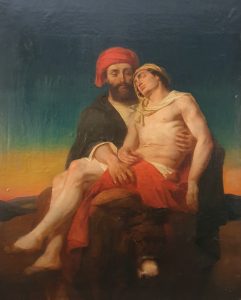
Attributed to François-Joseph Navez (1787 – 1869)
C. 1820, Oil on Canvas
Notice the similarity of composition between the Pieta of Michelangelo (in white Gypsum-Composite on the pedestal) and this painting of the Good Samaritan.
It is as the artist wants to explain the story of the Good Samaritan in a way that the vulnerable wounded man is to be a representation of Jesus Christ. Indeed, on a few occasions in scripture, Jesus identifies himself with people who are in need. Think for instance on the versus from Matthew 25:
“Then the king will say to those at his right hand, ‘Come, you who are blessed by my Father, inherit the kingdom prepared for you from the foundation of the world, for I was hungry and you gave me food, I was thirsty and you gave me something to drink, I was a stranger and you welcomed me, I was naked and you gave me clothing, I was sick and you took care of me, I was in prison and you visited me.’ …
…And the king will answer them, ‘Truly I tell you, just as you did it to one of the least of these brothers and sisters of mine, you did it to me.’”
The Pieta of Michelangelo is in Rome, where Navez worked for a few years.
Navez was a Belgian Neoclassical painter; known for his portraits and genre scenes.
In 1812, he was awarded first prize in a contest for history painting. This enabled him to go to Paris, where he worked and studied with Jacques-Louis David from 1813 to 1816. The following year he went to Rome, where he made the acquaintance of Ingres. He would live and work there until 1822.
Another example of his work from this period is ‘Hagar and Ismael in the desert’:
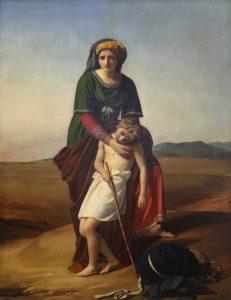
Notice the similarity between the two works.