

Last week as I walked through Zomba to the post office two men in front of me almost came to blows. Yelling, pushing, shaking fists, I couldn’t make out a single word of their high-volume, rapid-fire Chichewa. But I knew what they were arguing about: politics. One man was clad from head to toe in orange—the party colors of the ruling Peoples’ Party. The other was wearing a bright light blue shirt with the face of the late president Mutharika of the Democratic Progressive Party prominent on the front and back.
“Everywhere I hear the sound of marching, charging feet, boy/
‘Cause summer’s here and the time is right for fighting on the streets, boy.”
(“Street Fighting Man,” The Rolling Stones)
It’s election time in Malawi, with 20 May set for civic, parliamentary and presidential elections. Colored flags and party banners fly from the roadsides, rallies jam traffic in Zomba a few times a week, and the town is full of marching, charging feet. There are street fights too, and several people have been killed in partisan violence, although the general mood of the country ’til now has been one of peace and calm, thank God. Multi-party, western style democracy is relatively new in Malawi, although Africans in these parts had a long and proud tradition of electing their own leaders before colonial empires and then African dictators robbed them of it. For an outsider, it is fascinating to watch an African election unfold, although a little disquieting (we are beginning to stockpile a bit of extra petrol…just in case).
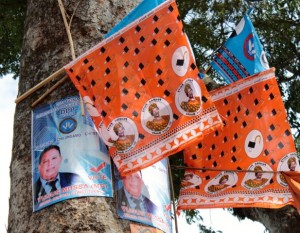 People being people, no matter where they come from, an election in Malawi doesn’t always look so different than in Canada. Here too voters have a pick of parties, even if politics seems a little incestuous. The United Democratic Front (UDF) took power in ’94 as the first democratically elected government after the demise of the dictator Hastings Kamuzu Banda, breaking off from Banda’s black/red/green Malawi Congress Party (MCP). The UDF leader, Muluzi, won two terms in office, then tried to stick around for a third, unconstitutional, term. “Who wants to be president for only two terms?” he famously asked. Now his son leads the UDF with dad lurking in the background. The party that broke off from the yellow UDF and took power from them, the Democratic Progressive Party (DPP) also held power for two terms, but their rule was cut short by the death in 2012 of their increasingly brutal leader, Bingu wa Mutharika. His brother now leads the DPP with Bingu’s ghost lurking in the background. And the current president Joyce Banda, broke away from the blue DPP a few years back to form her own party, the Peoples’ Party [PP]. Color them orange.
Confused? Me too. Just like in Canada, lofty promises and unrealistic pledges pour off the lips of the presidential hopefuls, as do accusations and contempt for their opponents. Sometimes the accusations do find target. Joyce Banda, who is a loyal and prominent member of the Church of Central Africa Presbyterian, started off well in office, with economic reforms, a welcome focus on women’s and children’s rights, and a deliberate rejection of the opulence of her predecessor, Mutharika. For example, she sold his luxurious presidential jet—a jet much hated in a country of often hungry peasants. But some of her gestures turned out hollow. That presidential jet was sold to a South African weapons dealer who also got a fat contract with the defensive department. Worst of all, President Banda’s time in office saw single biggest financial scandal in Malawi’s history, with tens of millions of dollars donated by foreign governments and NGOs for aid and development work ending up in the pockets of several of her ministers and officials. But as the recent senate scandal in Canada suggests, politicians everywhere have trouble keeping their hands out of the public purse. Of course, not all of Banda’s problems are her own fault (or more precisely the fault of her government). She is a woman, after all, and that is a definite handicap in this part of the world. Annika had an interesting chat a few months back with a local pastor. Lamenting the sliding currency during Banda’s time in office, he said (seemingly oblivious to the recent economic history of Zimbabwe), “we need a strong man like Mugabe here in Malawi. A strong leader makes a strong currency. And that’s why a weak woman can’t be president.” My German wife’s counter-argument that Germany’s president was a woman and the Euro was nevertheless strong didn’t seem to make much impact!
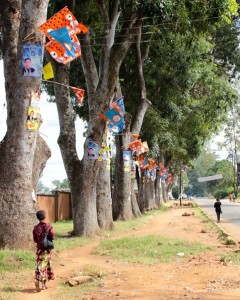 This is Africa, though, so certain things about a Malawian election strike a Canadian as very different. Have you ever seen a Canadian politician break out in a dance groove at a rally? Here, political parties hold loud, colorful rallies where supporters ululate, gyrate, and wave palm branches and flags. Because most Malawians don’t have a TV, we are mercifully spared the tedious political ads on the TV that bore Canadians during an election season. Instead, the evening serenity of our home is broken nightly by a man standing in the back of a (party-colored) pickup truck, yelling slogans into a loudspeaker for the whole neighborhood to hear.
Two other things strike me as different. First, there is no ideological spectrum in Malawian politics. This took me some time to figure out, and it was really only when I talked to some politicians that it got into my head. All parties run on essentially the same platform, promising basics like food security, education, and anti-corruption measures. The electorate decides which candidate they think can deliver on these basic promises, with voters having a definite leaning to trust candidates from their own tribe or region, and then to expect the winner to spread the benefits to “their” people.
Second, because Malawi is so religious—indeed, so overwhelmingly Christian—it surprises a Canadian to hear God and Jesus invoked so regularly and unashamedly. I can appreciate the candor. Christian politicians here don’t have to hide their faith as in Canada, or feign some sort of religious neutrality. Joyce Banda openly acknowledges the influence of Jesus on her policy making, and claims to be guided by his values of mercy, justice, and equality. The current MCP presidential hopeful is a bishop of the Pentecostal Assemblies of God, and often points to his track record in the church to recommend his political suitability. At the same time, all the presidential candidates are chronic breakers of the second commandment: “Thou shalt not take the Lord’s name in vain.” God is called in to bless their persons and vindicate their policies. Their opponents are regularly likened to Judas Iscariot. Seems to be a small step from believing God is on your side to believing your opponent is a devil!
Please keep Malawi in prayer over the next month. May God bless us with peaceful streets and bribe-free voting stations. And whoever our next president may be, may their pious words before the election be matched after the vote by integrity in leadership and justice in policy.