
God is in the small things, the gentle things, the subtle things. I am reminded of this as I see our Funding Team leader, Bibhu Singh hold the hand of a woman who has had a hard life. She was physically abused by her husband for 14 years before she spoke up in a UMN project women’s group and received the protection she needed. She has lasting ailments that continue to cause her pain. Yet she works hard, raising her four children, using the money from a small grocery stand to support her household, a grocery stand the UMN project helped her start. And Bibhu weeps in her compassion and the woman wipes tears from Bibhu’s eyes and I see the face of God.
In another village, we visit a blind man who is running a small grocery shop with the help of his wife and children. He has been blind for two years. For the first year, he did nothing, but then a UMN project helped him start the grocery shop which is now thriving and which allows him to support his family. I see his wife bring him tea and as she looks at him her face shines with love and again I see the face of God.
1 Kings 19: 11-13:
’11 “Go out and stand on the mountain,” the Lord replied. “I want you to be there when I pass by.” All at once, a strong wind shook the mountain and shattered the rocks. But the Lord was not in the wind. Next, there was an earthquake, but the Lord was not in the earthquake. 12 Then there was a fire, but the Lord was not in the fire. Finally, there was a gentle breeze,[a] 13 and when Elijah heard it, he covered his face with his coat. He went out and stood at the entrance to the cave. A voice asked, “Elijah, why are you here?””
The people UMN helps in its projects are not looking for handouts, they are just looking for an opportunity to escape the poverty which dominates their lives. It may seem a small thing, to help a person here and a person there, but in those small things you can see the face of God.
When I worked in UMN from 1992-1997, I was involved in multi-million dollar infrastructure projects that employed over a thousand Nepalis and many expatriates. Now I am visiting projects where there are just a handful of employees, but their work is no less important.
My wife, Lorna and I spent the last week visiting Tansen Hospital and UMN projects in Nawalparasi in the Terai (plains) area of Nepal. As always, Tansen Hospital was an inspiration with its high standard of care and where no one is turned away because they cannot afford to pay. Idealism is everywhere. There is Priscilla, a young Nepali nurse working in the hospital’s community development project. She told me that she could earn a lot more money if she worked in a foreign country, but she has chosen to stay in Tansen because she believes in and is committed to the ideals which Tansen Hospital stands for.
In the Terai, we visited a woman’s group in a poor Dalit (untouchable) village near the border with India. Caste discrimination is outlawed in Nepal, but it is still deeply rooted in Nepalese culture and the villagers are still feeling its profound effects. Domestic violence is a problem everywhere, but the women in this group gain help and strength from each other. Two are appointed ‘champions’ who confront the abuser and his family and seek to find ways to end the abuse. They also look for other ways to help and support each other.
In another location, we meet the young teenage members of a ‘Child’s Group’, who are elected by their peers after giving a speech about what they hope to accomplish if they are elected to be a member of the group. They meet regularly and seek out ways to have a positive impact in their communities by, for example, encouraging those who have dropped out of school to return and by trying to help young people who have become addicted to drugs. Their spirit and commitment is palpable.
At another place, we meet a group of disabled people who support each other in various ways and who get the help they need from a UMN project which allows them to participate fully in their communities. The stories are inspiring and are told with great pride and enthusiasm.
My conclusion: UMN projects still have the ‘wow’ factor and are changing lives of individuals and communities in a positive way and are inspiring idealism everywhere. UMN seeks out the most marginalized when deciding where to work.
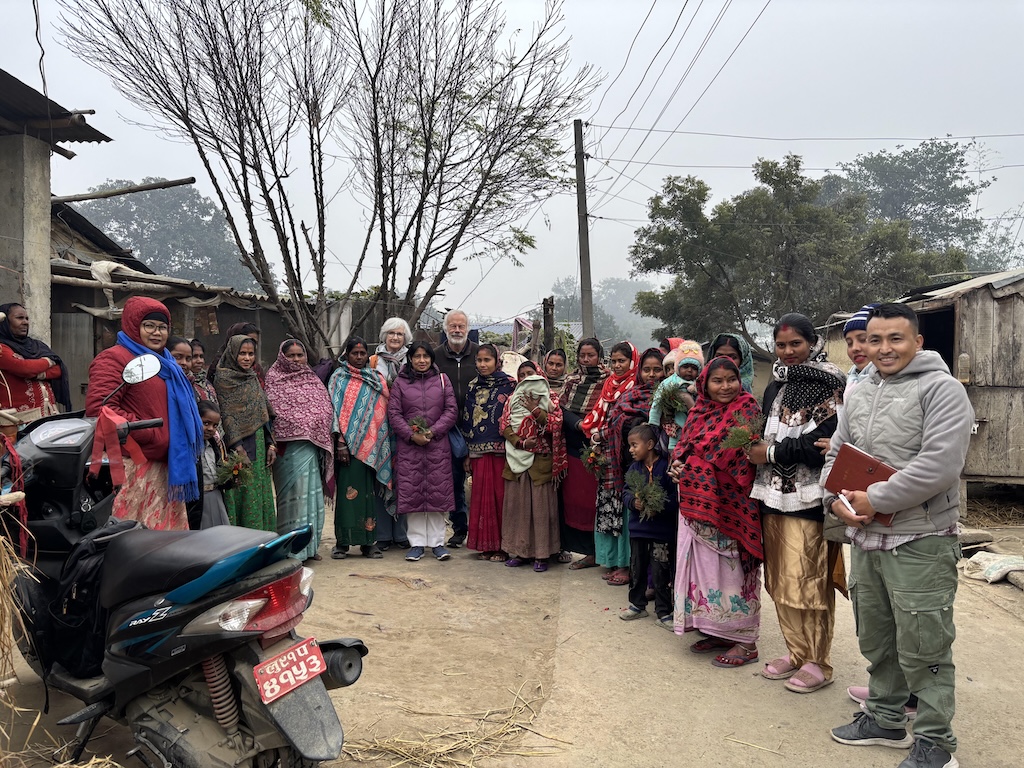
Lorna and Gerry Kent with Women’s Group in a Dalit Village