
As United Mission to Nepal’s (UMN) representative, I recently attended a three-day “Regional Humanitarian Conference” in Bangkok, Thailand.
Following the conclusion of the event, the organizers published a news release where they stated:
“The event brought together 517 aid practitioners, from 279 organisations and 38 countries representing the civil society, governments, UN agencies, private sector partners, academics, and crisis-affected community leaders from across Asia and the Pacific.”
They went on to say:
“Over the 3 days, participants focused on five areas of change: shifting power and resources to crisis-affected communities and local organizations; connecting climate, development, and humanitarian work; rethinking business models and financing; using data and technology responsibly; and operating in fragile and politically contested environments.”
The keynote speaker was Professor Michael Barnett, a leading scholar in the humanitarian field, who teaches at George Washington University. He discussed what it means to be compassionate in today’s world, noting how it can be fragile and fleeting, especially when popular sentiment turns against a compassionate response – as has been seen with the migrant crisis in many countries. He encouraged those in the humanitarian sector to guard against the tendencies which interfere with an unbiased response to those in need.
There were numerous panel sessions throughout the 3-day conference. I was able to attend 14 of them, which helped me get a better understanding of what approaches in development work seem to be yielding the best results.
It’s often said that at these types of conferences the most useful time is between sessions when you are able to meet people from other organizations and countries and learn about the work they are doing – something I experienced for myself, as I was able to meet a number of people, who shared helpful insights, including in subsequent email exchanges.
A colleague of mine at UMN said to me that if you provide essential infrastructure to a rural area – roads, electricity, water, cell coverage, etc- 80% of the population will be able to look after themselves. It is the remaining 20% – the ones who tend to be left behind, who need some help. It is that segment of the population that UMN targets in its development work, especially the poorest of the poor, the most marginalized. I am looking forward to visiting its projects in the rural areas to get a better understanding of UMN’s work.
One might ask, what does God see as the most important development work? Yes, He does care about the poor, but it is easy to overlook what is the greatest commandment: to love God with all of your heart, mind and soul. In other words, the development of a sincere love for God is of prime importance – and in fact if a true love for God is present, there can’t help but be a compassionate response to human need – since we will see and love in others the image of God.”
-
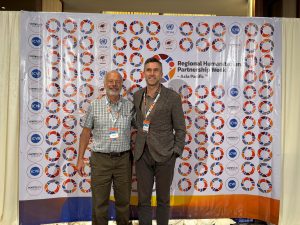
- Gerry Kent and his son Stephen Kent

-
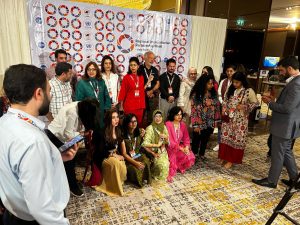
- Gerry Kent with other participants at the conference