

Mitch Rhodes writing. I am starting this blog with a report on my trip to Doti, a district in the far west of Nepal. I was invited to tag along with a colleague of ours from UMN headquarters in Kathmandu. Bishal is in charge of the six rural “clusters” in Nepal. He was making a routine visit to Doti to check up on the various projects UMN is working on, so I joined for a learning tour. Even though most of my work is with the expat doctors and other expat aid and development workers who are either in one of two hospitals or based in Kathmandu, going to Doti felt applicable for me in terms of getting to know the current UMN context, and because some of the Kathmandu based expats do get out to the remote clusters a few times a year as well. Doti is also a place we send UMN expat trainees for our short-term program for college-age people, and a few young Dutch trainees are travelling to Doti this coming winter. Lora and I are in charge of their time in Nepal. So all in all, it was a good opportunity for me to get to know this place.
So those are the reasons I was able to go on this trip. But, I was just so happy to explore a new place where few tourists go. I got to see firsthand what I only knew from the UMN website, publications, and stories from colleagues. Another bonus was that I got to practice my Nepali in a rich and authentic environment. My fellow UMN staff are all fluent in English, but most often converse in Nepali. The meetings I sat in on were all in Nepali, of course, and luckily, most of the local groups we met with speak standard Nepali, albeit sometimes with a few regionalisms and Hindi words thrown in.
I came from Kathmandu with Bishal, our aforementioned “Programme Partner Team Leader.” Our 75-minute domestic flight was from Kathmandu to Dhangadhi, on the plains of far southwest Nepal. It’s actually the furthest west you can fly from Kathmandu on a daily basis and still be in Nepal. The UMN Doti cluster driver, Prakash, met us there in the UMN vehicle, a double-cab pickup (seats 5) with a topper on the back. It was a two-hour drive up into the hills to the small town of Budar, where seven staff work in the UMN Doti cluster office. Most of us back home would call this area “mountains”, but as they aren’t the high Himalayas, they are only hills to Nepalis. It’s more like the Appalachians in the Eastern US.
Throughout the trip, I discovered that Prakash is a superstar driver! He routinely has to drive UMN cluster staff to various remote parts of Doti. During my six days there he had to navigate
- across flowing rivers,
- over roads that had become rivers in the rain,
- around landslides (well, the aftermath of the landslides which our colleage dug out with a shovel),
- over rocky roads with boulders the size of bowling balls that sometimes had to be moved out of the way.
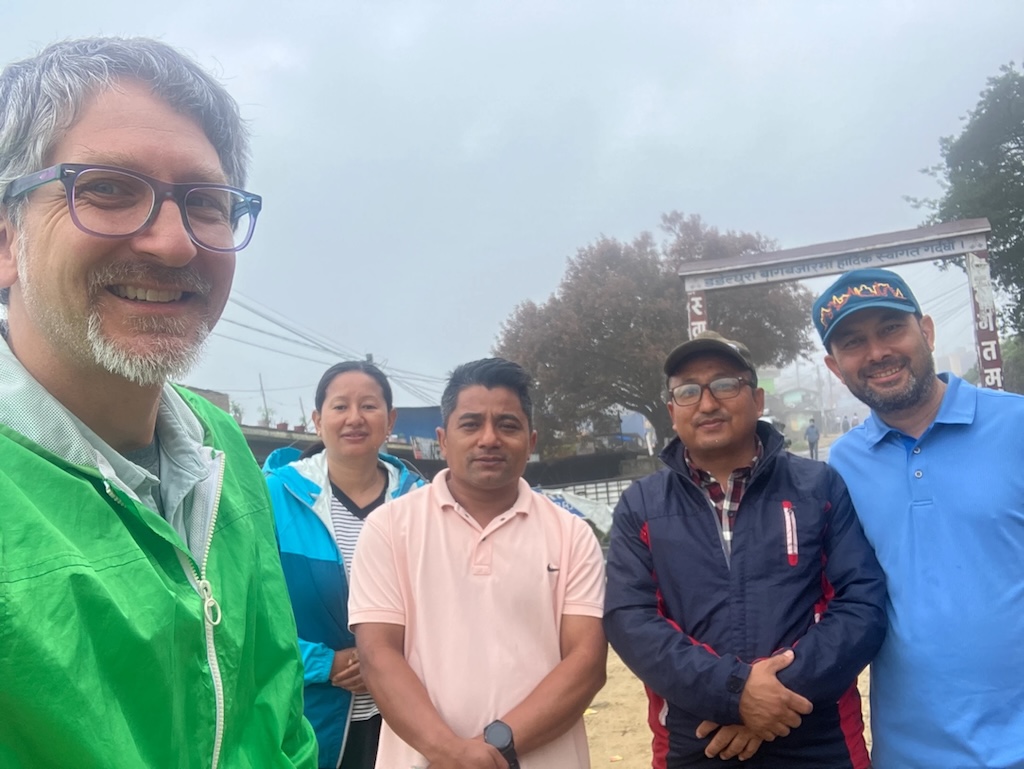
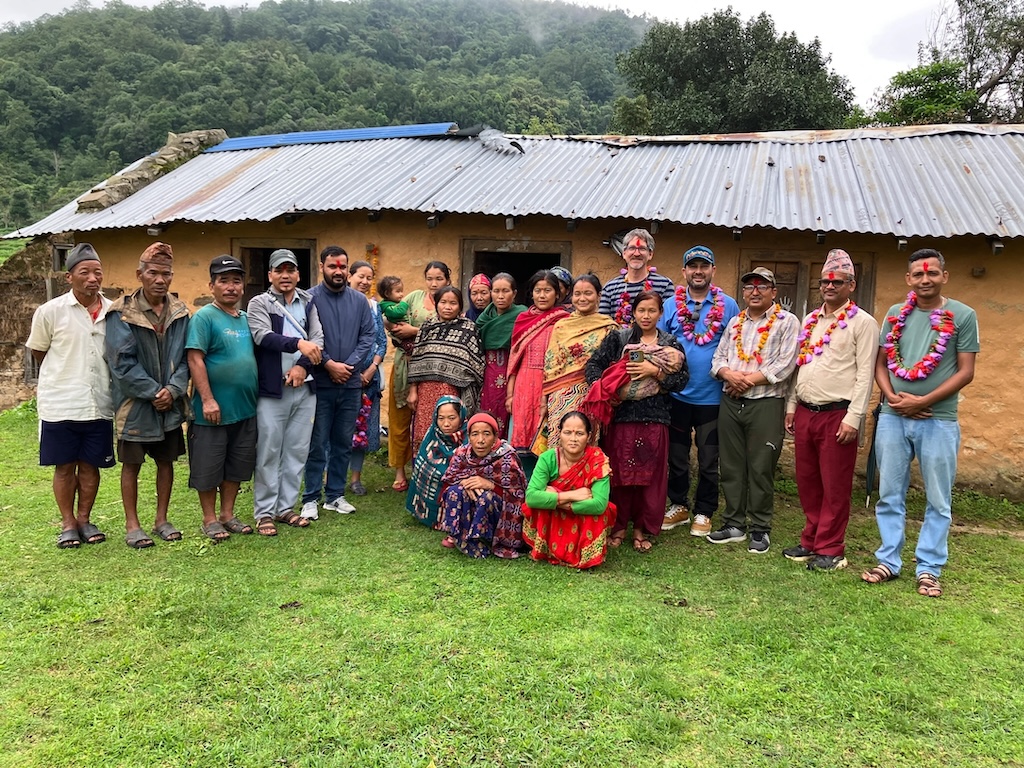
The other UMN staff with us over the six-day trip were Sharmaya, who works in health, and Ram Sharan, who works in livelihoods. Photo on left below: L to R: Me, Sharmaya, Prakash the driver, Ram Sharan, and Bishal, the team leader from Kathmandu. More about the tikkas (red marks on our foreheads) later.
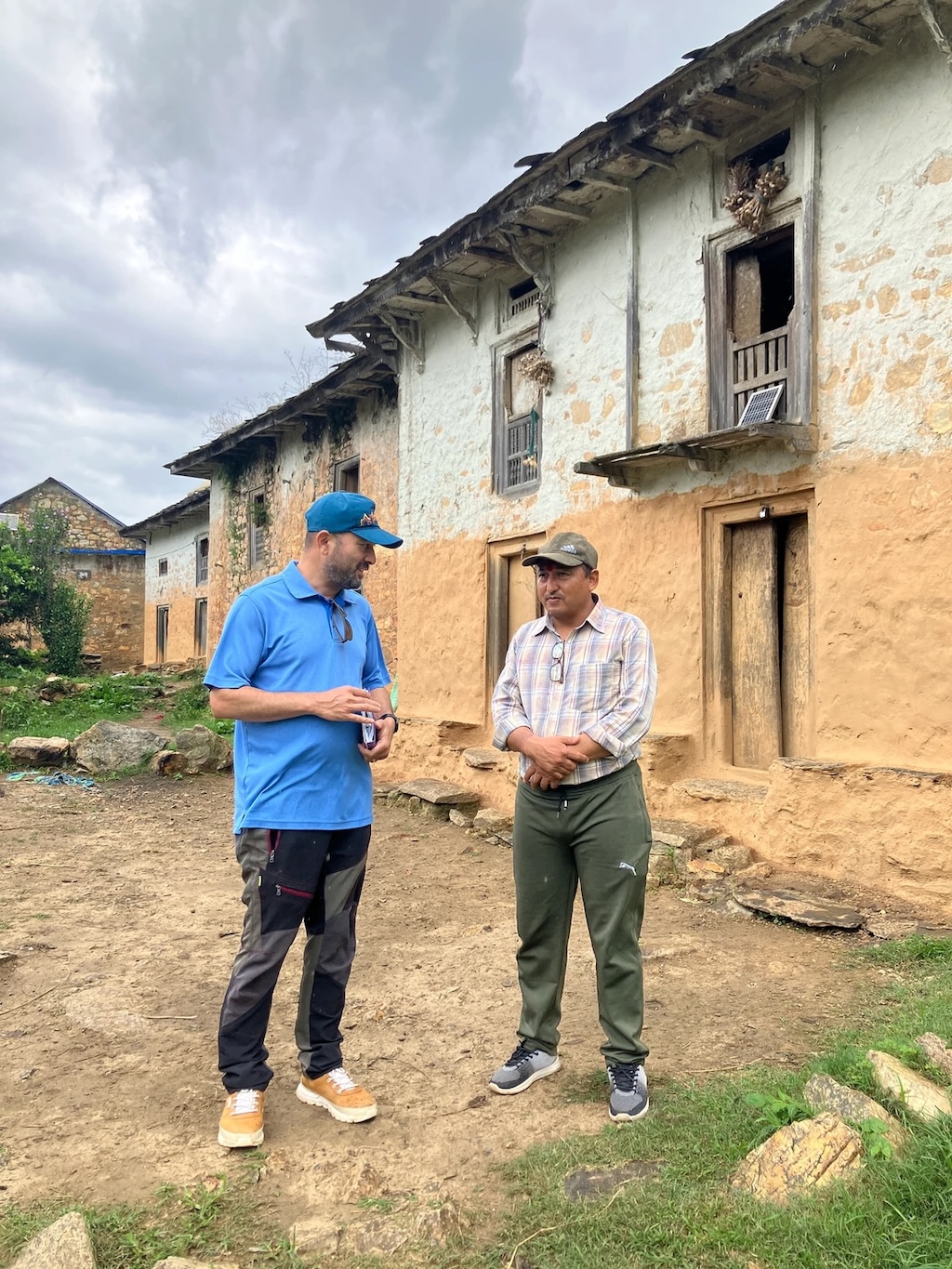
Work in Sharmaya’s area, health, is fairly straightforward- give people access to quality and affordable medical care and teach them about sanitation, preventative practices, etc. However, the field of livelihood work, which is Ram Sharan’s focus, was new to me before I came to UMN and the world of development work. It is basically helping create or find opportunities for employment or income generation. These poor rural areas see so many young people go to work in other countries or sometimes urban areas within Nepal. Those leaving are mostly men, but also women. This, of course, puts a strain on families and relationships. It is hard for those leaving and also for those staying back who have to manage the household and often the farmwork with fewer adults to help out. So, giving people jobs right in their village is much better. As it is currently, about 25% of Nepal’s GDP is from money sent home by those young people working abroad. Every day, over 2,000 young people leave Nepal for work in foreign countries: India, other places in Southeast Asia or the Middle East, Korea, Japan, Europe, and elsewhere. One village we visited consisted of 28 households, and out of all those families, only four working-age adult men were currently there. Most of the rest of the men were all in India for seasonal work, generally low-paid day labor jobs.
Some of our time was spent meeting with the UMN local partner organizations. Since UMN is an international NGO, by law, we are not allowed to do any direct implementation (our hospitals are an exception). So when UMN supports a farmer just getting started with her own greenhouse, it’s actually the “social mobilizer” from the local partner office that UMN works with who arranges for the training on building and maintaining the greenhouse. In one group we met with, the farmers only had to pay 20% of those costs, and the rest was funded by UMN, given through the local partner.
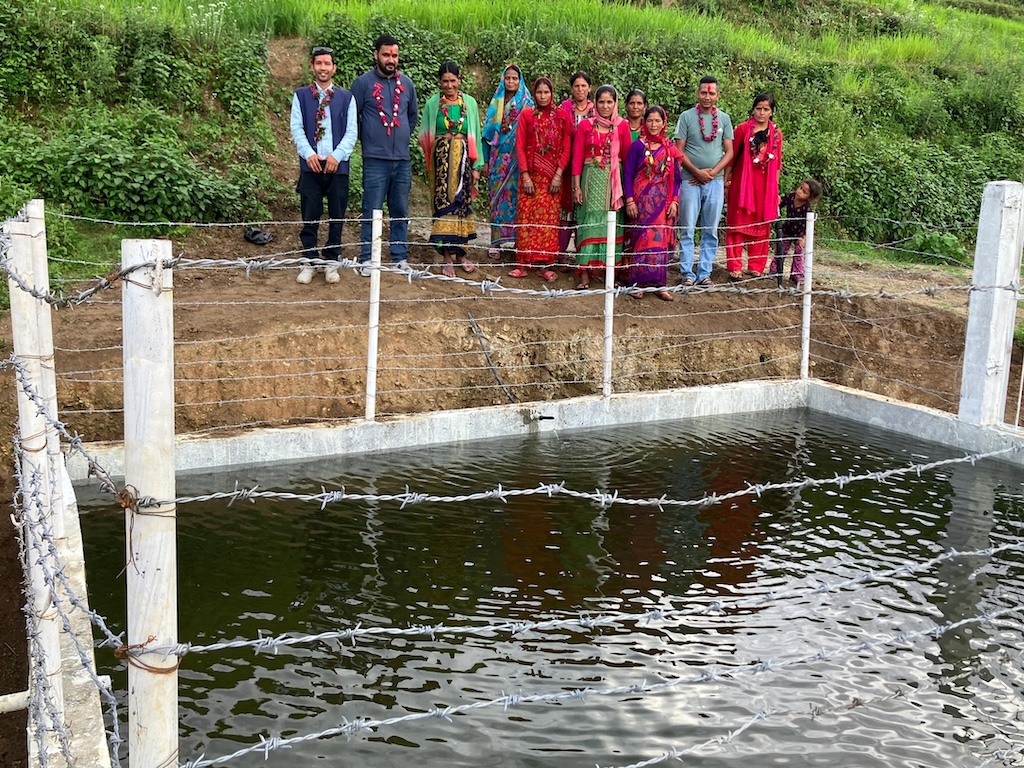
Below are a few photos of the women’s groups we met. Some were specifically farmer groups. Others focused more on parenting and non-agricultural income generation. The group posing behind what looks like a swimming pool surrounded by barbed wire were actually proudly showing us their newly built irrigation pond. Farmers in Nepal have used irrigation for centuries, but irrigation ponds are something newer, and they are finding them indispensable due to recent weather pattern fluctuations with climate change. Local river flows can no longer be counted on as a reliable source of water when needed. These women have also been growing citrus such as lemons and oranges, which UMN and other development groups are encouraging as erosion control and more climate change resilient crops. The men in the photos were mostly from the local partner organizations or sometimes other folks from the village hanging around and getting in the group picture.
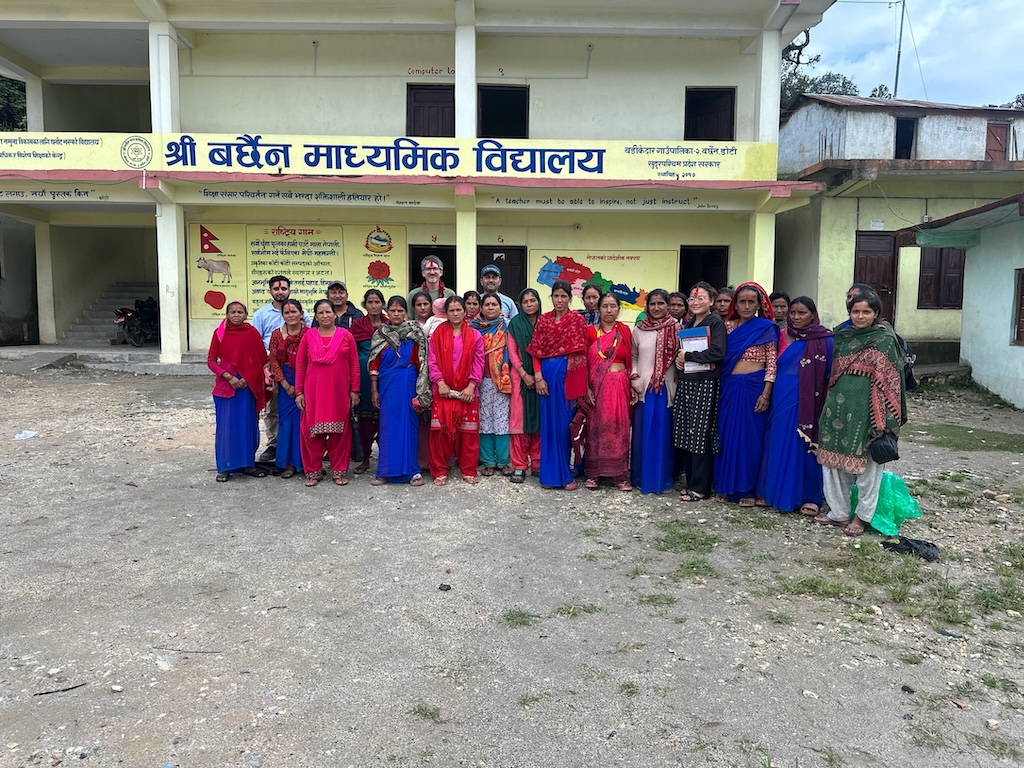
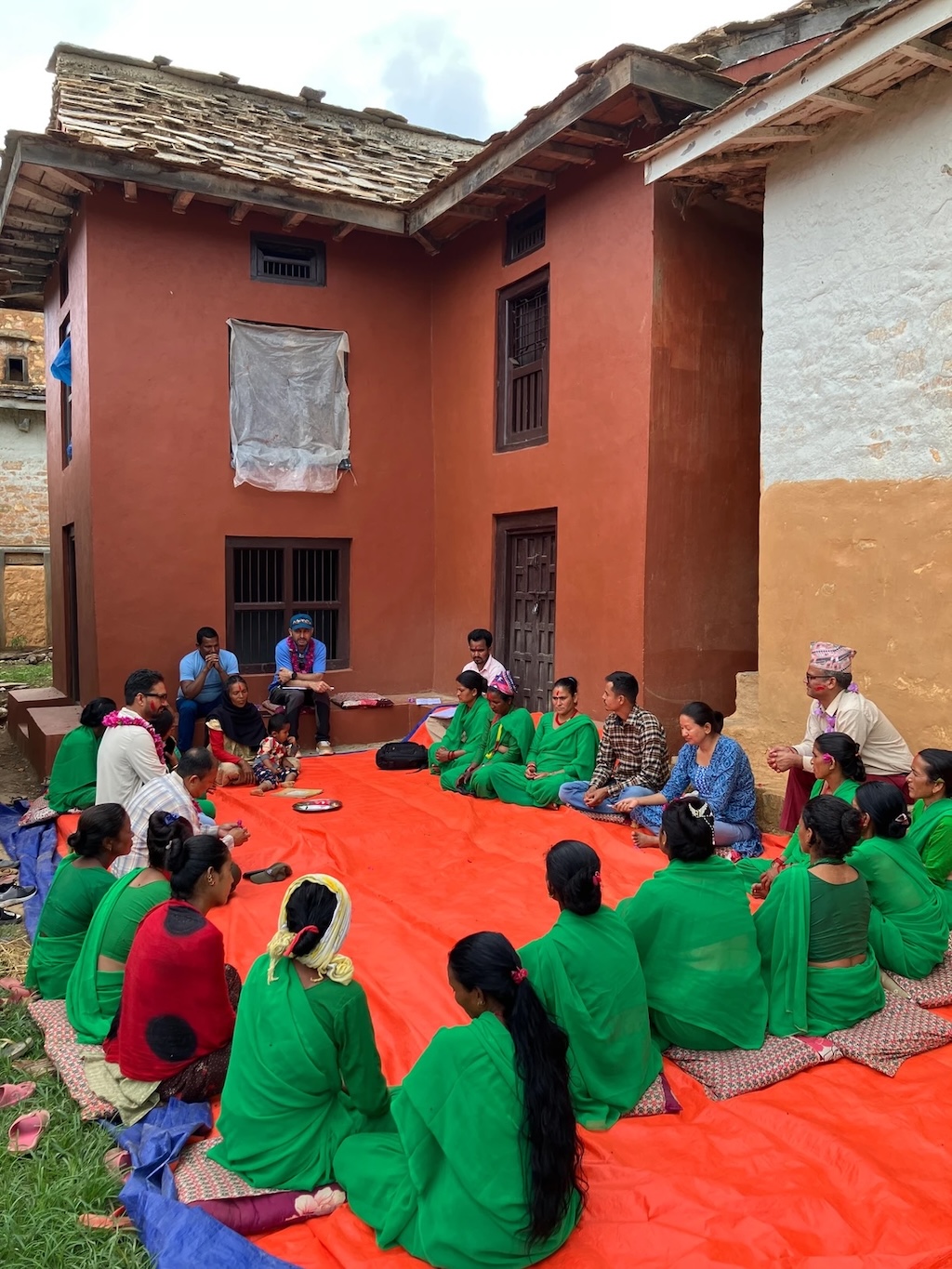
In this district of Doti alone there are around 80 groups working with our local partners. My colleague, Bishal, is talking about the importance of reducing plastic usage and, more importantly, not burning it. Oh, and it starts with two of the three welcome songs they sang for us. It was evident to me how important these groups were to the members for support, connection, and ideas, as well as how much UMN and its partner organizations are deeply respected and appreciated wherever they work.
You will also notice that most of the visitors in these meetings, me included, have a tikka (red smudge of vermillion powder) on their forehead and are sporting a freshly homemade garland of whatever flowers they had blooming. The tikka was applied, and the garland was draped over us each time with a bit of formality at the start of the meeting. Unfortunately, I didn’t get that little ceremony on video, although it happened eight times over those few days. Also, what is interesting is that Nepali Christians don’t receive a tikka because of its association with Hindu worship practice. I, as a foreign Christian, however, have more latitude to receive it, and was told by my Christian UMN colleagues that refusing it would be disappointing or even insulting to our hosts, thus I got a lot of red powder on my forehead (and some spilling on my clothes, which came out in the wash eventually.)
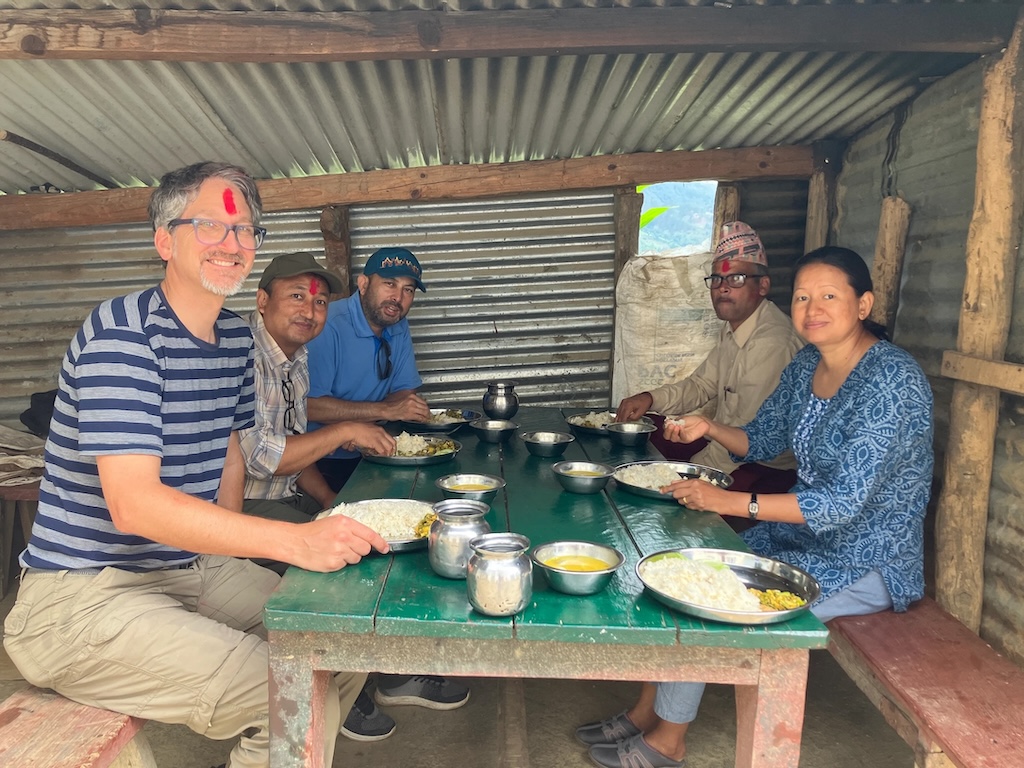
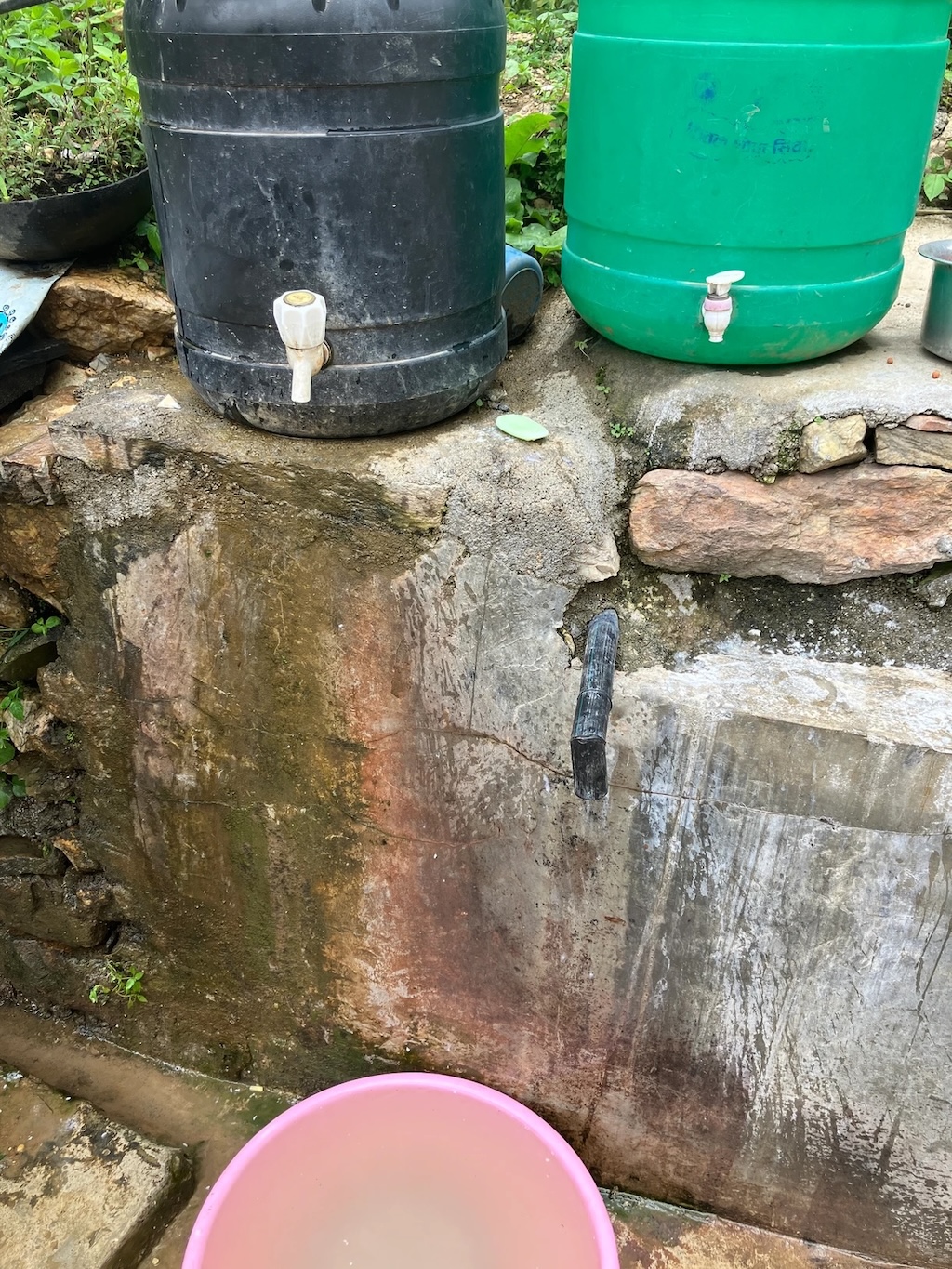 After some more meetings we had lunch (dal bhat, i.e. rice, lentil soup and vegetables, of course!) in a tiny restaurant run by one of the green sari women. See photos below. Notice the handwashing station, including a bar of soap on the ledge between the two water tanks. Also, it’s totally appropriate to hang your garland somewhere random after the meeting is done. I donated mine to the goat tied up outside the restaurant that day. By the way, many of the women’s groups UMN works with are encouraging goat farming as a source of income. We saw lots of goats in our visits, which apparently wasn’t as common in this region years ago. Goat meat can fetch a good price in the local market or in nearby larger towns. The goat milk, however, is not usually drunk by people or sold. Also, no yummy chevre cheese around there.
And still more photos of this area are below. The first two pictures are to show the rice planting. You can tell the seedlings were freshly transplanted because they are so spindly, and the paddy is full of water. It’s the monsoon now, which makes it rice planting season (mid June to mid July, basically) -and also leech season! In the pictures below, behind the women who are bent over planting rice, the dome-shaped thing is made of last year’s dried corn stalks (minus the ears of corn, of course), which is fed to livestock during the dry season.
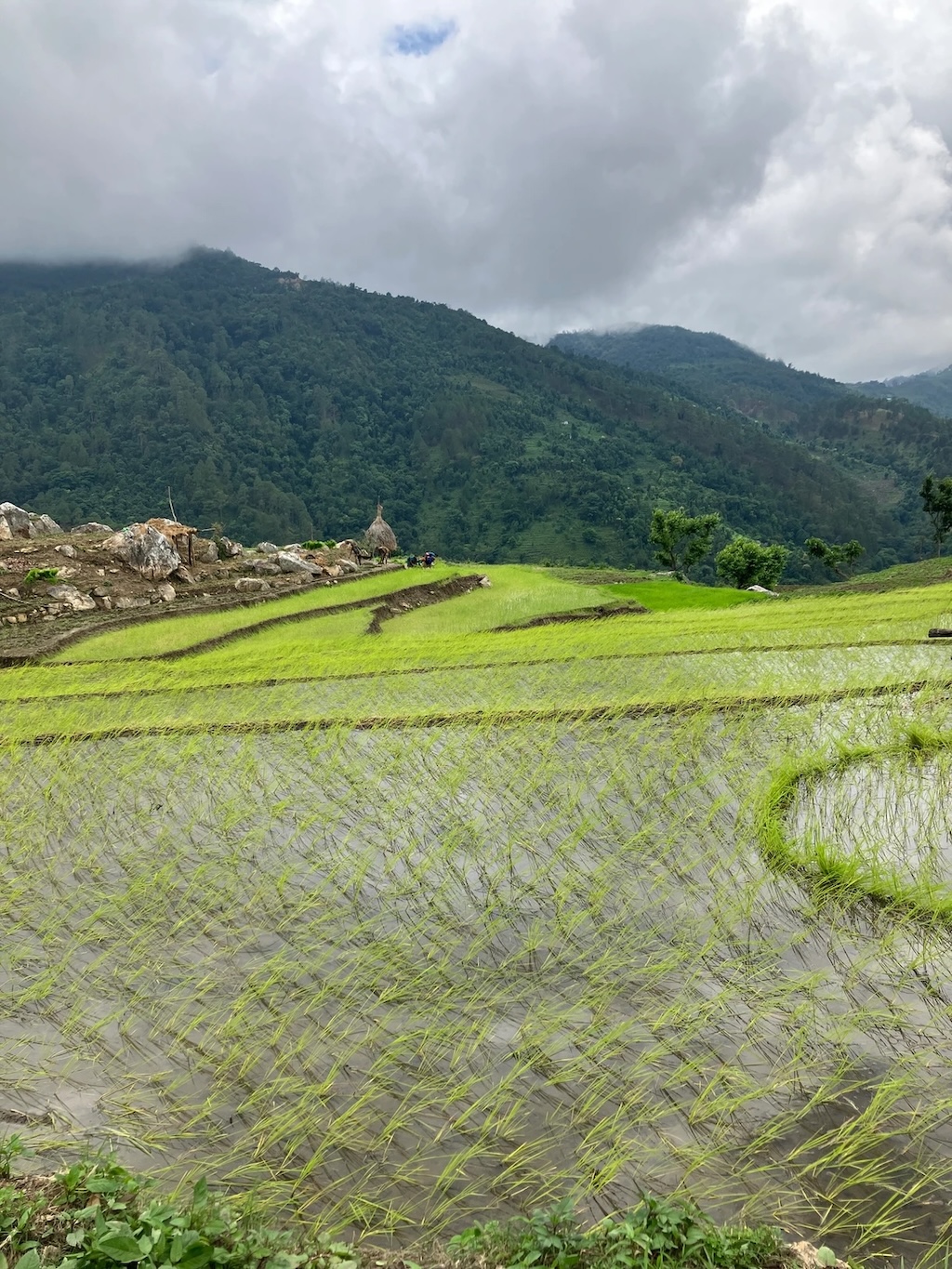
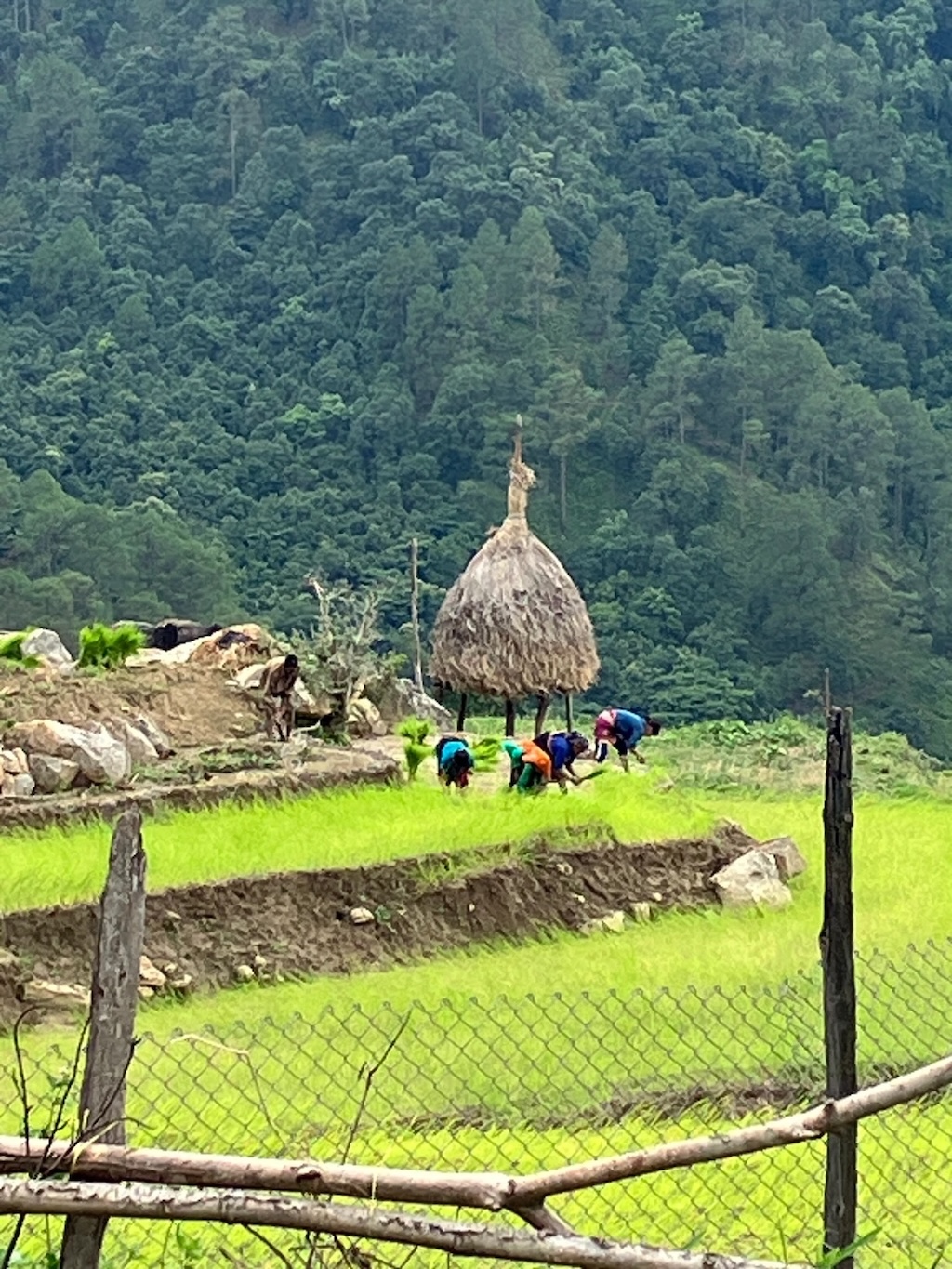
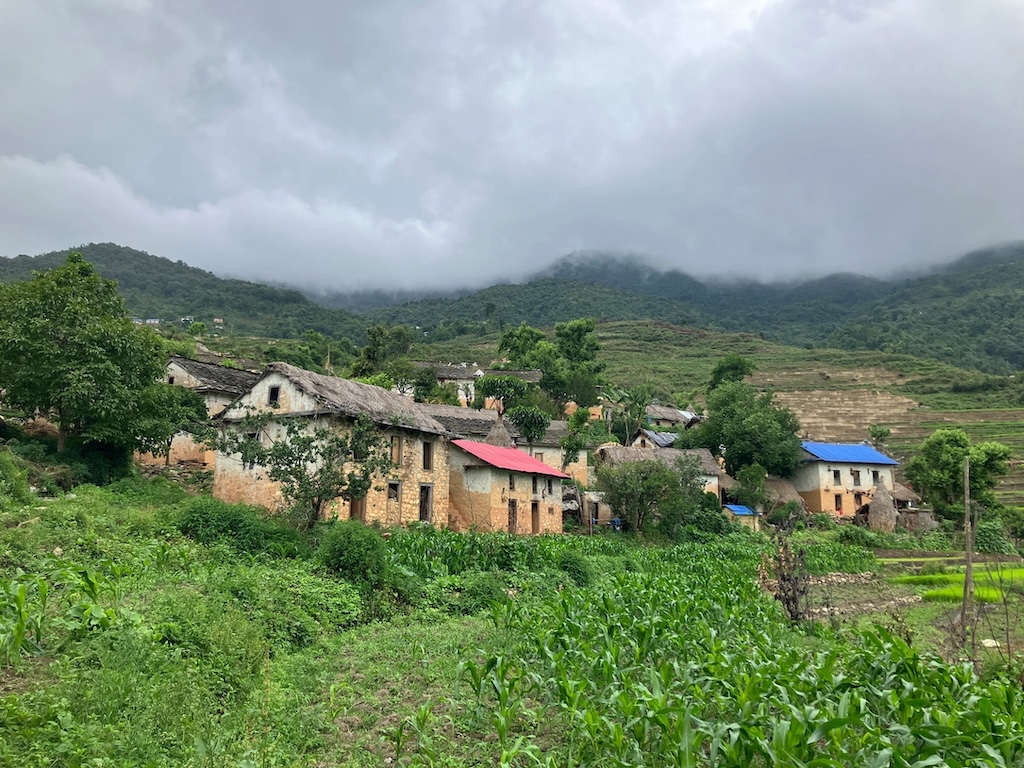
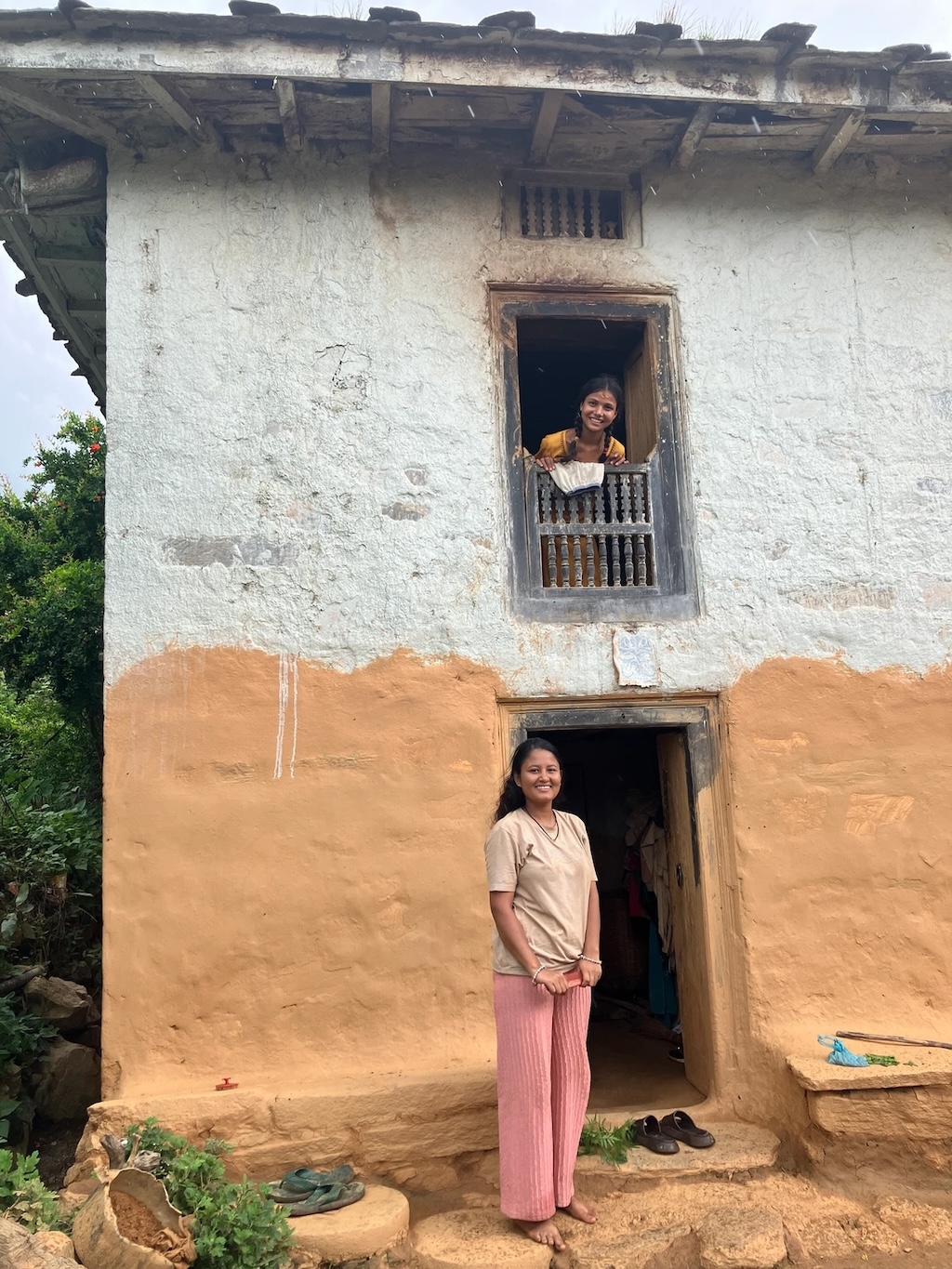
One striking story from a farmer’s group highlighted the importance of designing relevant and meaningful projects that truly benefit the intended recipients. We were meeting this particular group of farming women in a community building, and pushed to the side of the room was a large loom with beautiful blue thread, with what looked like a complicated weaving project, but only half-finished. I was curious and had Bishal ask the women about the loom because it hadn’t come up in the discussion. He asked them, and they told us that a few months before, there was a foreign donor group that came to the village with the loom and materials and held four days of woven arts training for the women. But after they left, even though they now knew how to make the cloth, none of the women continued this project. There is no market or need for this work, and thus no point. It was sad but a good example of the importance of basing projects on what the people need and want.
Parts of each meeting I saw included Bishal leading a discussion on ideas for future projects to make sure that whatever UMN does in these areas is actually going to be useful and meaningful for the people we are trying to help. Yay for UMN, although this idea seems like a low bar to clear. Unfortunately, not all aid and development is as carefully designed and distributed.
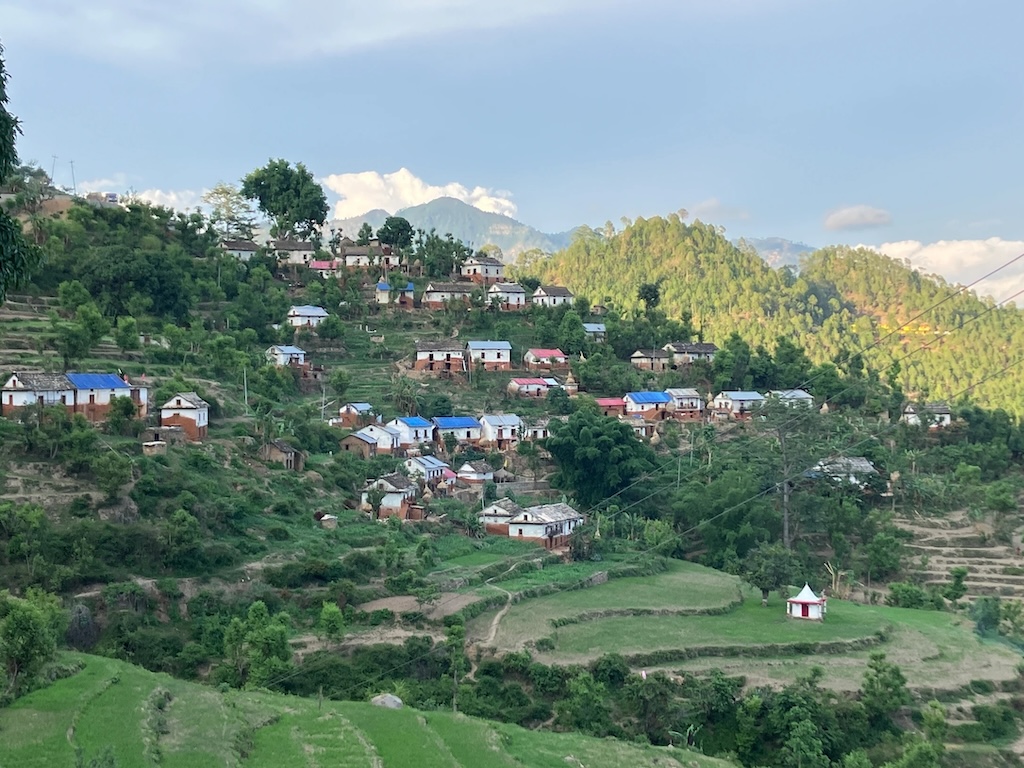
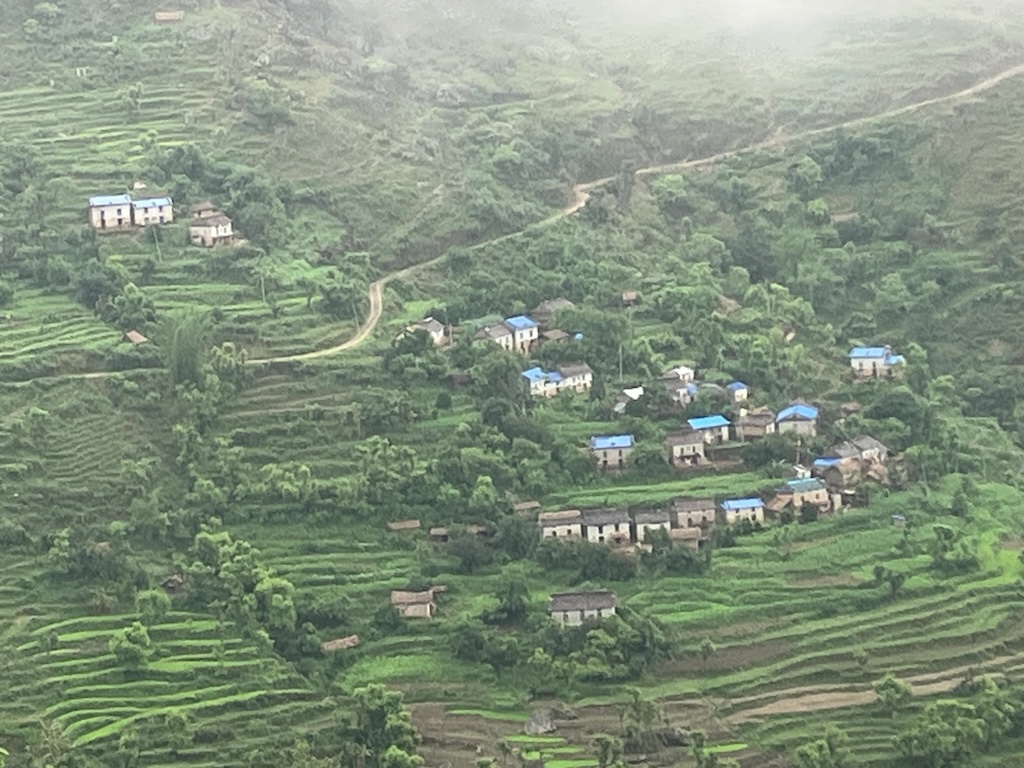
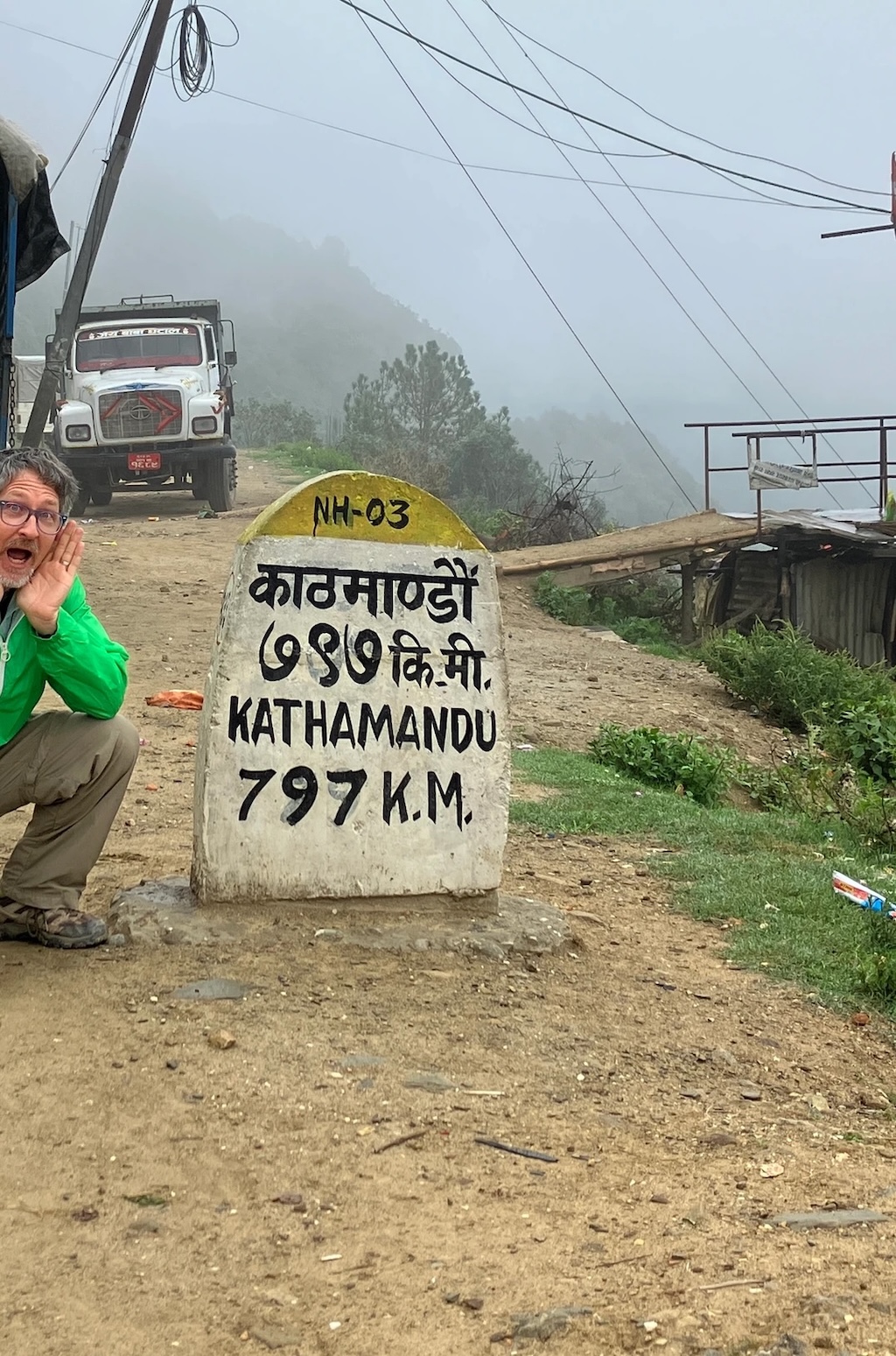
Below you can also see a picture of a village on a hillside, which I photographed with my phone camera’s zoom lens. It was maybe a half mile away as the crow flies, but lay on the opposite side of a steep gorge, and to reach it from our vantage point, it would have taken another hour to walk on the path which hugged the sides of the valley. If the road hadn’t had a washout, we could’ve continued in the UMN pickup and reached it in ten or fifteen minutes, but as it was, we had to skip visiting that group of UMN-supported goat farming women for lack of time. There’s also a goofy photo of me reacting to the distance from Kathmandu posted on the mile marker. And a photo of a group of school children we met.
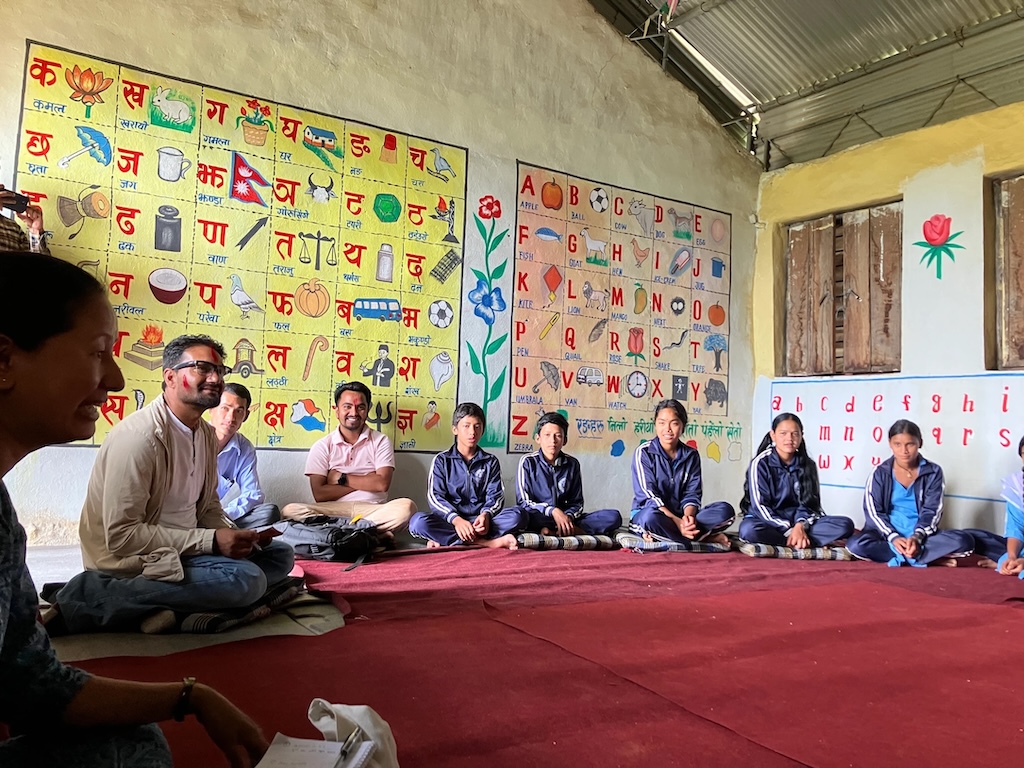
The group of children we met were roughly between the ages of 11 and 14, with 25 participants who gather regularly for discussions and education on practical issues not always covered in regular school classes. Their K-10 school has 190 students and is just up the path from the village with the women in the green saris. The group discussed matters such as what to be aware of and how to stay safe when going abroad for work (when they are older). For example, the kind man who might come to your village promising you a nice job working in a restaurant in a foreign country might actually be taking you to work in a brothel, which you wouldn’t find out until he dropped you off, basically as a prisoner with no way of returning home.
The group also discusses the importance of staying in school (harmful and long-term effects of child labor) and especially waiting for marriage until 20 (for women) and 21 (for men). Those ages are a recent Nepali law, but in many rural areas, child marriage is still common because it’s been a tradition for centuries. In poor rural areas of Nepal, child marriage is often seen by families as a practical solution to poverty and social pressure, especially for girls. Marrying off a daughter early can reduce the financial burden on the household (because the bride traditionally moves in with the groom’s family and is thus one less mouth to feed for her parents). Limited access to education and fear of unwanted relationships or pregnancy also push families toward early marriage. While harmful in the long term, families may feel they have no better option due to a lack of support, opportunity, and awareness. So, making the kids aware of these issues is an important way to secure their future. Sharmaya, my UMN colleague leading that discussion, encouraged them to spread the word on these and other issues to the rest of their schoolmates. The group was capped at 25 for various reasons, but more children always applied than could be accepted.
Whew! You’ve made it this far in the blog post, and all I’ve written about is my trip to Doti, which was only four days if you don’t include the travel to and from Kathmandu. My eyes were definitely opened as I saw firsthand the important work UMN does with the poor rural communities of Nepal. Of course, I’ve been in deep rural Nepal before, but only on trekking trips, and this was completely different. Tourists generally do not come to Doti.